
PROCESS CONTROL HARDWARE
ADS16 16-Channel 16-Bit I2C ADC Module
Sixteen high-precision analog channels on one board, over a single I2C interface. Built around four genuine Texas Instruments ADS1115 delta-sigma converters, with dual I2C ports for daisy-chaining and per-channel thermistor support.
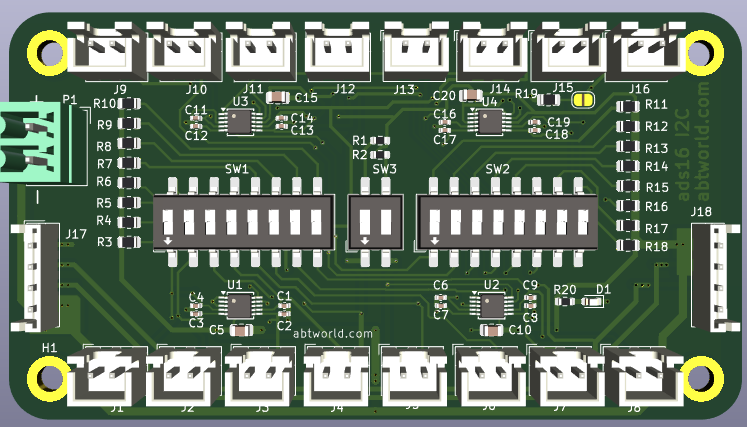
Overview
The ADS16 eliminates wiring clutter, signal degradation and I2C address conflicts when you expand analog inputs. Four ADS1115 converters give 16 single-ended channels — or 8 differential — on a clean, unified bus.
Dual I2C ports allow pass-through bus wiring, an optional auxiliary power input feeds isolated or high-load sensor rails, 16 locking XH-2.54 connectors land the sensors, per-channel DIP switches select the input mode, and channel 16 reads supply voltage for ratiometric calibration. It is built for professional data acquisition, thermal mapping and embedded instrumentation.
Key features
- High-density 16-bit conversion. 4 × genuine TI ADS1115 ICs give 16 single-ended or 8 differential channels on a single PCB.
- Dual I2C ports for daisy-chaining. Two on-board headers allow pass-through bus wiring, so additional I2C sensors or peripherals chain on without external splitters.
- Optional auxiliary power input. Power the board and its sensors from the host I2C bus, or use the dedicated external terminal to isolate the analog supply rail and eliminate voltage drop over long runs.
- Zero-conflict address scheme. All four ADS1115 ICs are factory-addressed (0x48, 0x49, 0x4A, 0x4B) and operate concurrently on the primary bus.
- Plug-and-play XH-2.54 connectors. 16 latching sockets for analog sensors, potentiometers and NTC probes — no breadboard.
- Per-channel DIP mode switching. 16 independent switches select, channel by channel, between raw voltage measurement and an integrated NTC 3950K pull-up divider.
- Ratiometric VDD tracking on channel 16. Channel 16 reads the supply rail directly, so software can calibrate against power supply drift in real time.
Technical specifications
| Parameter | Specification |
|---|---|
| ADC architecture | 4 × Texas Instruments ADS1115 (delta-sigma) |
| Resolution | 16-bit (15-bit single-ended plus sign) |
| Channel count | 16 single-ended / 8 differential |
| Operating voltage (VDD) | 2.0 V to 5.5 V DC — 3.3 V or 5 V typical, host or auxiliary input |
| Operating temperature | -40°C to +85°C |
| Current consumption | 50 mA maximum |
| Power inputs | I2C header or auxiliary power terminal |
| I2C connectivity | 2 × parallel I2C ports (input / pass-through daisy-chain) |
| I2C addresses | 0x48, 0x49, 0x4A, 0x4B — four banks of four channels |
| Sample rate | 8 SPS to 860 SPS, software programmable |
| PGA full-scale ranges | ±0.256 V, ±0.512 V, ±1.024 V, ±2.048 V, ±4.096 V, ±6.144 V |
| Sensor interface | 16 × JST XH-2.54 connectors |
| Thermistor support | NTC 3950K, integrated high-precision series bias resistors |
Hardware configuration and operating modes
Dual I2C bus topology
Plug the master microcontroller into port 1 and daisy-chain displays, RTCs or further sensor boards from port 2.
Power supply flexibility
Standard mode: powered directly from the microcontroller rail via the primary I2C header.
Auxiliary power mode: the dedicated power port feeds clean, regulated power straight to the analog circuitry and the pull-up networks.
Channel mode selection (DIP switches)
DIP off — standard ADC: bypasses the internal bias resistors for 0 V to VDD active signals, transducers and op-amp outputs.
DIP on — thermistor mode: switches in the on-board precision series resistor to complete a voltage divider for 3950K NTC thermistors.
Real-time VDD compensation
Channel 16 is routed to the supply rail, so readings on the other channels can be corrected against the measured VDD rather than an assumed one.
Package contents
- 1 × ADS16 16-channel 16-bit I2C ADC module
- 1 × 4-pin I2C connection cable (XH-2.54 to DuPont)
- 1 × hardware setup and pinout reference sheet
Designed for the plant floor, not the bench
General-purpose hobby boards do the same arithmetic, but they are not built to survive an industrial environment. Talk to us about the electrical and environmental requirements of your application.